Gaurav Bhatia
Founder & Software Architect

A business owner often notices the technology problem before they know its name. Orders slow down because staff re-enter the same data in three places. A booking system fails during the busiest hour of the week. Reports take days to assemble, so decisions arrive late. At that point, the issue is no longer "an IT problem." It is a revenue, customer experience, and growth problem.
An IT consultant helps you diagnose that problem and choose the right fix. The role works a lot like an architect reviewing a building before any construction starts. They assess what already exists, identify weak points, and map out what should change so the business can operate with less friction and less risk.
Business owners often get stuck at the same point. They know something needs to improve, but the options blur together. Should you replace software, connect the tools you already have, tighten security, move to the cloud, or build something custom?
A strong IT consultant brings structure to that confusion. They connect business goals to technical decisions, so you spend money on systems that support growth instead of collecting more software subscriptions and more complexity.
The best firms go a step further. Traditional IT consulting often stops at advice, which leaves your team holding a blueprint without a builder. Hybrid consulting firms close that gap by handling both strategy and implementation, so the plan can turn into working systems, trained staff, and measurable results.
Table of Contents
- Introduction: When Technology Becomes a Roadblock
- What an IT Consultant Actually Does
- Common Specializations: Finding Your Expert
- When to Hire an IT Consultant: Key Business Triggers
- IT Consulting in Action: Industry Examples
- Engagement Models and Pricing: What to Expect
- How to Choose the Right IT Partner
- From Advice to Action: The Single-Vendor Advantage
Introduction: When Technology Becomes a Roadblock
A business owner feels it in the workday before they see it on an org chart or project plan.
Orders go up, but inventory still gets updated by hand. Customer support asks customers to repeat information because systems are disconnected. Reports take days because sales, operations, and finance each keep data in a different place. The business is growing, yet everyday work keeps getting harder.
Technology stops being a tool and starts becoming a roadblock when the company spends more time working around systems than using them.
At that point, an IT consultant helps by looking at the business as a whole. The job starts with questions. What is slowing revenue down? Where are employees wasting time? Which systems no longer fit the way the company operates? As explained by Indeed's overview of the IT consultant job description, an IT consultant assesses current systems and infrastructure, identifies gaps, evaluates feasibility, and aligns technical needs with business goals and budget.
That matters because the visible problem is often only the symptom. A slow website may point to a hosting issue, poor code, or a process bottleneck behind the scenes. Repeated customer service mistakes may come from disconnected tools, unclear workflows, or bad data being passed from one system to another. If you only fix the surface issue, the same frustration usually returns in a different form.
If you can describe the pain but not the root cause, you probably need consulting before you need development.
The best consulting goes one step further. Traditional IT consultants often stop at advice. They diagnose the issue, recommend a plan, and hand it off. Hybrid firms close the gap between strategy and execution by helping you choose the right fix and then putting it into practice. For a business owner, that means fewer handoffs, less confusion, and a better chance that the recommendation becomes a working result.
An IT consultant helps you understand what is wrong, what is possible, and what should happen next so the business can operate with less friction and better direction.
What an IT Consultant Actually Does
A common perception of a consultant involves meetings, slides, and advice. Good IT consulting is much more practical than that.
The job follows a simple flow. Find the hidden problem. Choose the right solution. Guide the work until the result is usable and applicable in a business context.
According to Robert Half's explanation of IT consultant skills and workflow, an IT consultant's core workflow involves three steps: identifying and analyzing hidden problems in business processes and IT tools, proposing specific IT systems or software, and managing the project lifecycle while acting as the bridge between the client and execution teams.
They start with diagnosis
This is the part many owners skip because they are in a hurry.
A consultant looks at your current setup and asks plain business questions. Where does work slow down? Where do mistakes happen? Which tasks are manual? Which system causes complaints from staff or customers? They may review tools like Microsoft 365, a cloud environment on AWS or Azure, a Shopify store, a custom Node.js backend, or a reporting workflow built around spreadsheets.
The point is not to judge your setup. The point is to uncover what is really causing friction.
Then they design the treatment plan
Once the problem is clear, the consultant recommends a path. Sometimes the answer is new software. Sometimes it is integration between tools you already own. Sometimes it is process redesign, better security controls, or moving old infrastructure into a cloud platform.
Business owners often get confused because they assume the best solution is the biggest one. It usually is not.
A smart consultant tries to match the fix to the goal. If your team wastes time because inventory and orders do not sync, you may need APIs and workflow automation, not a total rebuild. If your customer data is scattered, you may need a cleaner architecture and reporting model, not another dashboard.
Good consulting reduces unnecessary work. It does not create more of it.
Then they guide implementation and improvement
Advice alone is not enough. Someone has to turn the plan into tasks, priorities, and deadlines.
That is why many consultants also coordinate developers, cloud engineers, security teams, designers, and stakeholders. They keep the project tied to the original business goal so the work does not drift into technical busywork.
In simple terms, an IT consultant helps a business answer four questions:
- What is wrong: Where is the underlying problem hiding?
- What should we change: Which tools, systems, or processes fit the need?
- How should we do it: What order, timeline, and budget make sense?
- How do we know it worked: Are daily operations now easier, safer, or faster?
That is the practical version of what an IT consultant does. They turn a confusing technology problem into a clear business decision.
Common Specializations: Finding Your Expert
IT consulting is a broad category, and the right fit depends on the problem you need solved. A business owner dealing with security risk needs a different expert than one planning a cloud migration or a custom software build.
Hiring by specialty saves time.
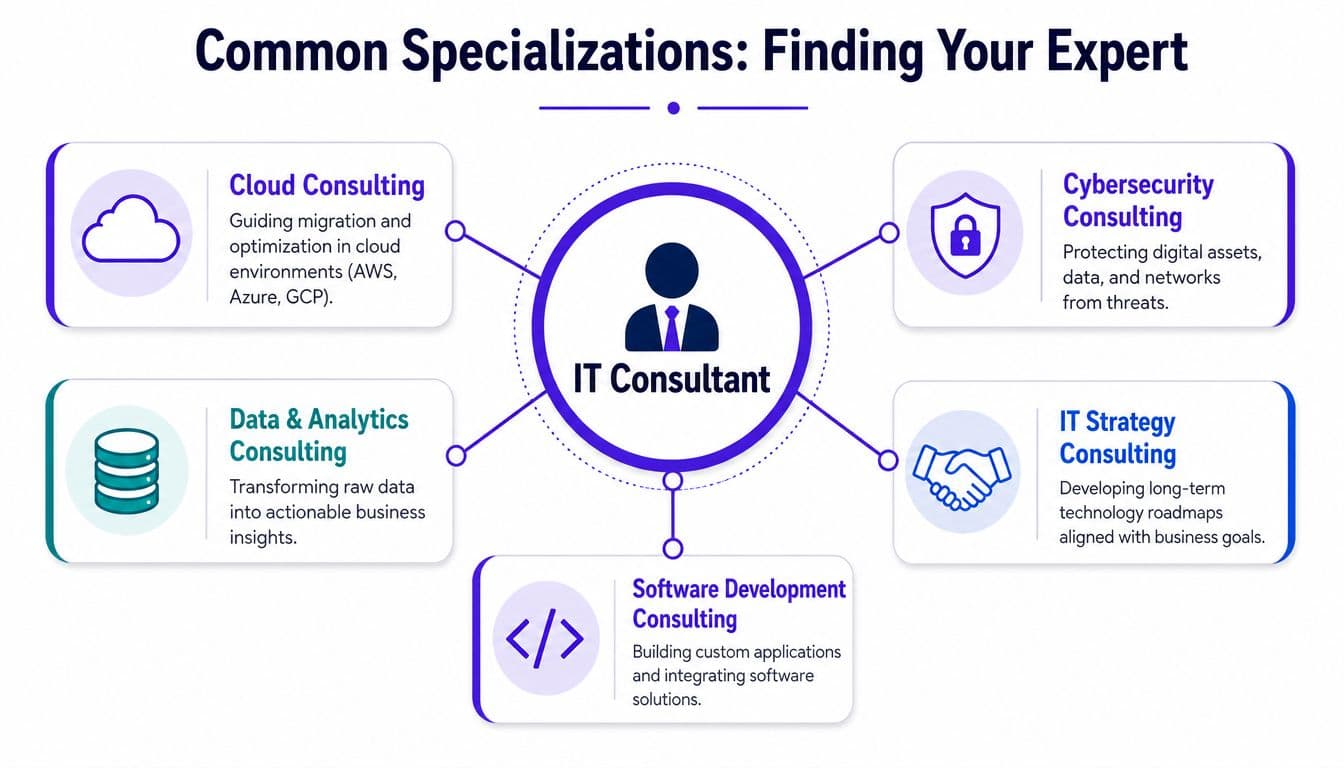
Strategy and planning consultants
Strategy consultants work at the business decision level. Their job is to help you choose the right direction before your company spends money on the wrong tool, the wrong vendor, or the wrong project scope.
They are useful when leadership has a goal but no clear technical path. You may want to improve customer service, reduce manual work, launch a digital product, or replace disconnected systems. A strategy consultant maps those goals to practical options, tradeoffs, timelines, and budget priorities.
For example, a company may want a customer portal but not know whether it should buy software, build a custom platform, or connect several existing systems. A strategy consultant helps frame that decision in business terms first, then technical terms second.
Infrastructure and cloud consultants
Infrastructure and cloud consultants focus on the foundation your business runs on. That includes servers, networks, hosting, cloud platforms, performance, reliability, and disaster recovery.
If your systems slow down during busy periods, your team struggles with outdated on-premise equipment, or you need to move into AWS, Azure, or Google Cloud, this is the specialty to look for. Their work is less visible to customers, but it affects daily operations in a direct way. A weak foundation creates recurring outages, delays, and frustration. A well-designed one gives your team room to grow without constant firefighting.
Cybersecurity consultants
Cybersecurity consultants help reduce business risk. They review how data is stored, who can access it, where your weak points are, and what protections need to be in place.
This matters more as a company grows. More employees, more devices, more software subscriptions, and more customer data all create more ways for problems to happen. A security consultant may assess permissions, endpoint protection, backup practices, vendor risk, compliance needs, and incident response planning.
Their value is not limited to installing security tools. Good security work also changes habits, processes, and decision-making across the business.
Software and data consultants
Some consultants specialize in software delivery. Others specialize in data. In many businesses, those two areas overlap because software creates the data your team depends on.
A software consultant may help define the architecture for a custom platform, plan integrations between systems, or scope a web or mobile product so development starts with clear requirements. A data consultant may focus on reporting pipelines, dashboard logic, data quality, and the structure behind better forecasting or operational decisions.
If your sales, inventory, finance, and customer systems do not line up, a data specialist can help fix the flow of information. If your staff keeps switching between disconnected tools, a software consultant can help design a better system.
The gap many businesses miss
Choosing the right specialty is only part of the decision. You also need to know whether the consultant only advises, or can help carry the plan through execution.
That distinction matters. A strategy firm might give you a smart roadmap, but your team still has to find developers, cloud engineers, security specialists, or integration partners to do the work. That handoff often creates delays, finger-pointing, and expensive rework.
Hybrid consulting firms solve this better. They can assess the problem, recommend the right approach, and then help implement it with the same business goal in view. For a non-technical business owner, that usually means fewer gaps between plan and outcome.
The best expert is not just someone with the right specialty. It is someone whose specialty matches your bottleneck and who can help turn advice into results.
When to Hire an IT Consultant: Key Business Triggers
A common pattern looks like this. Sales are growing, staff are busy, and the business seems healthy on the surface. Then small technology problems start stacking up. Orders get re-entered by hand, reports do not match, customers wait longer for answers, and one system change creates two new problems somewhere else.
That is usually the point where an IT consultant becomes useful.
You do not need a consultant because technology exists. You need one when technology starts blocking the business goal. A good consultant helps you figure out whether the root cause is the system, the process around it, the way tools connect, or the fact that no one owns the full plan.
The signs usually show up in daily work
One trigger is missing expertise at a key moment. Your team may be excellent at running operations but have no experience with cloud migration, payment security, data architecture, or software scoping. That gap matters most when the decision is expensive to reverse.
Another trigger is project complexity. Some changes look simple from the outside, but they work like a building renovation. Replacing one wall is easy until you discover wiring, plumbing, and load-bearing beams behind it. A cloud move, ERP integration, app launch, or AI feature has the same problem. It touches process, security, vendors, budget, and training at the same time.
Fresh perspective is another reason to bring someone in. Internal teams often know the workarounds so well that they stop seeing them as warning signs. An outside consultant can trace where time is being lost, where data gets duplicated, and where the business is relying on fragile manual steps.
Compliance is a clear trigger too. If you handle customer data, process payments, operate in a regulated field, or rely on systems that cannot afford downtime, outside guidance can prevent expensive mistakes. In that situation, technology decisions are not just technical. They affect revenue, customer retention, and operational risk.
If a project touches revenue, customer trust, or business continuity, trial and error usually costs more than expert planning.
Why timing matters
Business owners often wait until a project is already slipping. By then, the consultant is being asked to fix delays, budget overruns, and conflicting vendor advice instead of helping shape the project correctly from the start.
That is an important distinction.
Traditional IT consulting often stops at recommendations. You get an audit, a roadmap, or a slide deck that explains what should happen next. Then your team still has to find the right people to implement it, coordinate handoffs, and absorb the risk if the plan meets real-world obstacles.
Hybrid firms close that gap. They can assess the problem, recommend the approach, and help carry it into execution. For a business owner, that usually means fewer delays between decision and result, fewer misunderstandings between strategy and delivery, and clearer accountability when something needs to change.
A simple checklist can help you decide:
- Bring in a consultant when expertise is missing: You understand the business problem, but not the safest or fastest technical path.
- Get help when projects cross departments: The work affects operations, finance, customer experience, compliance, or multiple vendors at once.
- Call one when systems create manual work: Staff are re-entering data, switching between disconnected tools, or relying on spreadsheets to fill process gaps.
- Bring one in before risk becomes urgent: Security, compliance, uptime, or customer-facing systems are too important to fix after a failure.
- Choose a partner who can also implement: Advice is useful, but execution is what changes the business.
IT Consulting in Action: Industry Examples
Theory helps, but business owners usually understand faster when they see what consulting looks like in real work.
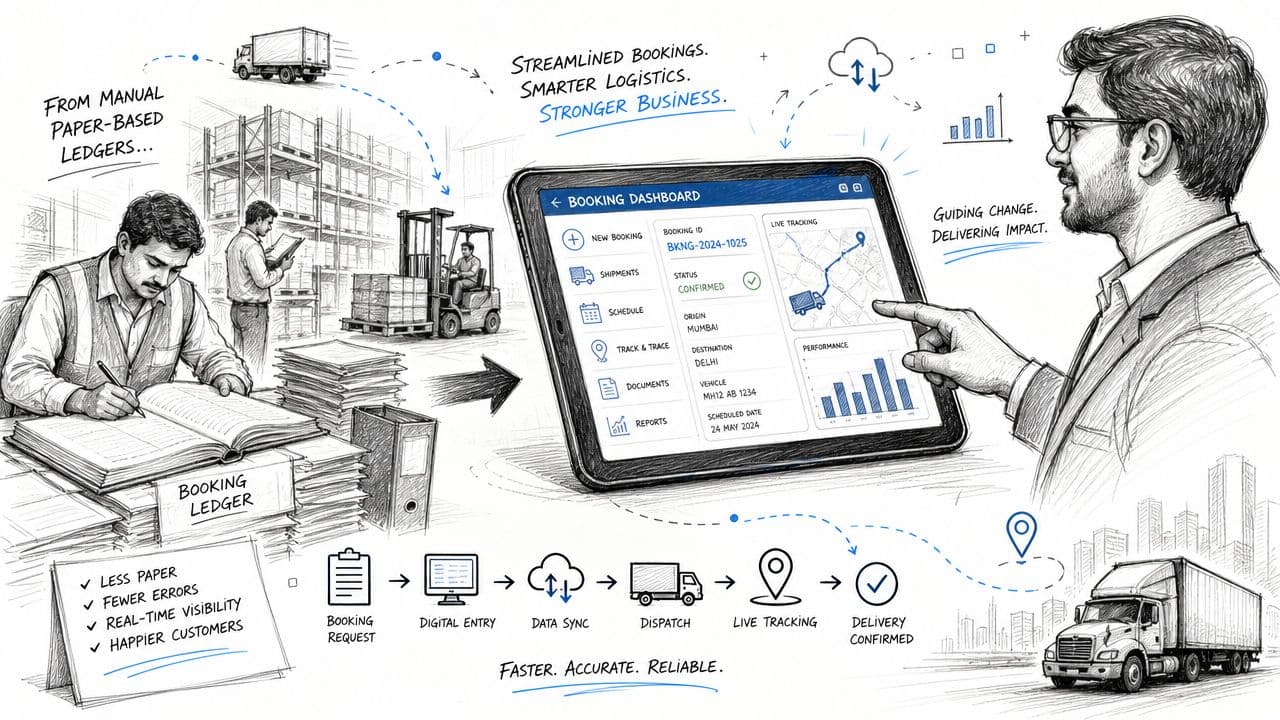
Logistics and operations
A transport company may start with phone calls, spreadsheets, and paper-based booking notes. That works for a while. Then order volume grows, drivers need faster updates, and office staff spend too much time checking the same details in different places.
An IT consultant would begin by mapping the process from booking to dispatch to invoicing. They would look for repeated manual steps, delays, and data errors. The likely recommendation could include a central dashboard, a booking workflow, role-based access for staff, and integrations that reduce duplicate entry.
The business result is not "better technology" in the abstract. It is fewer manual handoffs, faster processing, and clearer visibility across operations.
Fintech and payments
A fintech startup often has a different problem. The team may move quickly on product ideas, but payments, data security, and compliance need more structure than a rough prototype can handle.
Here, a consultant might define the system architecture before the team writes too much code. They can help choose how payment services connect, where sensitive data should and should not live, how audit logs should work, and what access controls are needed. They also help translate business goals into technical rules developers can follow.
For the founder, this lowers risk. For the engineers, it creates a map instead of a guessing game.
The best consulting examples do not start with code. They start with a business problem that people can describe clearly.
E-commerce and digital growth
An e-commerce business may hit a growth wall when the storefront, inventory tools, content system, and customer support process no longer work well together.
A consultant might recommend a headless architecture, improved API design, better search and filtering, or a cleaner content workflow through platforms like Shopify, WooCommerce, Contentful, or Sanity. They may also identify where performance issues come from and how the system should scale during campaigns.
The outcome is practical. Customers get a smoother buying experience. Internal teams spend less time correcting product, stock, or order issues.
Startups building an MVP
Early-stage founders often ask a different question. They do not want a complete platform yet. They want to know what the smallest useful version should be.
An IT consultant can turn a rough idea into an MVP roadmap. That means deciding which features are core, which can wait, what tech stack fits the budget, what should be manual at first, and what absolutely must be built right from day one.
That kind of guidance protects startups from a common mistake. They build too much before they validate what customers need.
Engagement Models and Pricing: What to Expect
Once you understand what an IT consultant does, the next question is usually practical. How do you work with one?
The answer depends on the type of problem, the size of the project, and how much flexibility you need.
The three common ways to work together
Some businesses need a consultant for a clearly defined project. Others need steady guidance over time. Others already have a team and just need extra capacity in a specific area like cloud, security, or backend development.
Here's a simple comparison.
- Project-based: Best for well-defined work with a clear outcome, such as a systems audit, migration plan, or architecture review. Fixed scope or milestone-based pricing. Lower flexibility once scope is set.
- Retainer-based: Best for ongoing strategy, advisory support, regular reviews, or long-term technology leadership. Monthly fee for continued access and support. Medium to high flexibility.
- Team augmentation: Best for adding specialist skills to your in-house team for delivery work or short-term gaps. Per person, usually monthly or contract-based. High flexibility for changing capacity.
A project-based model works best when you know what problem needs solving. For example, you may need a cloud readiness assessment, a technical due diligence review, or a roadmap for rebuilding an old internal portal. This model is easier to budget because the scope is defined up front.
A retainer model fits businesses that need regular help but not a full-time executive or technical lead. You might use this for quarterly planning, vendor reviews, architecture guidance, security oversight, or ongoing product strategy.
Team augmentation is different. In this model, the consultant or consulting firm supplies individual experts who work with your internal team. That is useful when you need a DevOps engineer, cybersecurity specialist, or senior architect without going through a long hiring cycle.
A few practical questions can help you choose:
- Is the work clearly defined: If yes, project-based is often the cleanest fit.
- Will new needs appear month after month: If yes, a retainer may make more sense.
- Do you already have internal leadership: If yes, augmentation can fill skill gaps without changing your whole structure.
- Do you need advice, execution, or both: This is the question many businesses forget to ask early enough.
That last question matters because pricing is only one part of value. The more important issue is whether the engagement model matches the work that needs to happen.
How to Choose the Right IT Partner
A lot of business owners meet two firms that sound equally capable on the first call. Both say they can modernize systems, improve security, or clean up a messy stack. A few weeks later, one engagement produces a practical plan your team can act on. The other produces confusion, delays, and a document no one knows how to use.
The difference usually shows up long before the contract is signed.
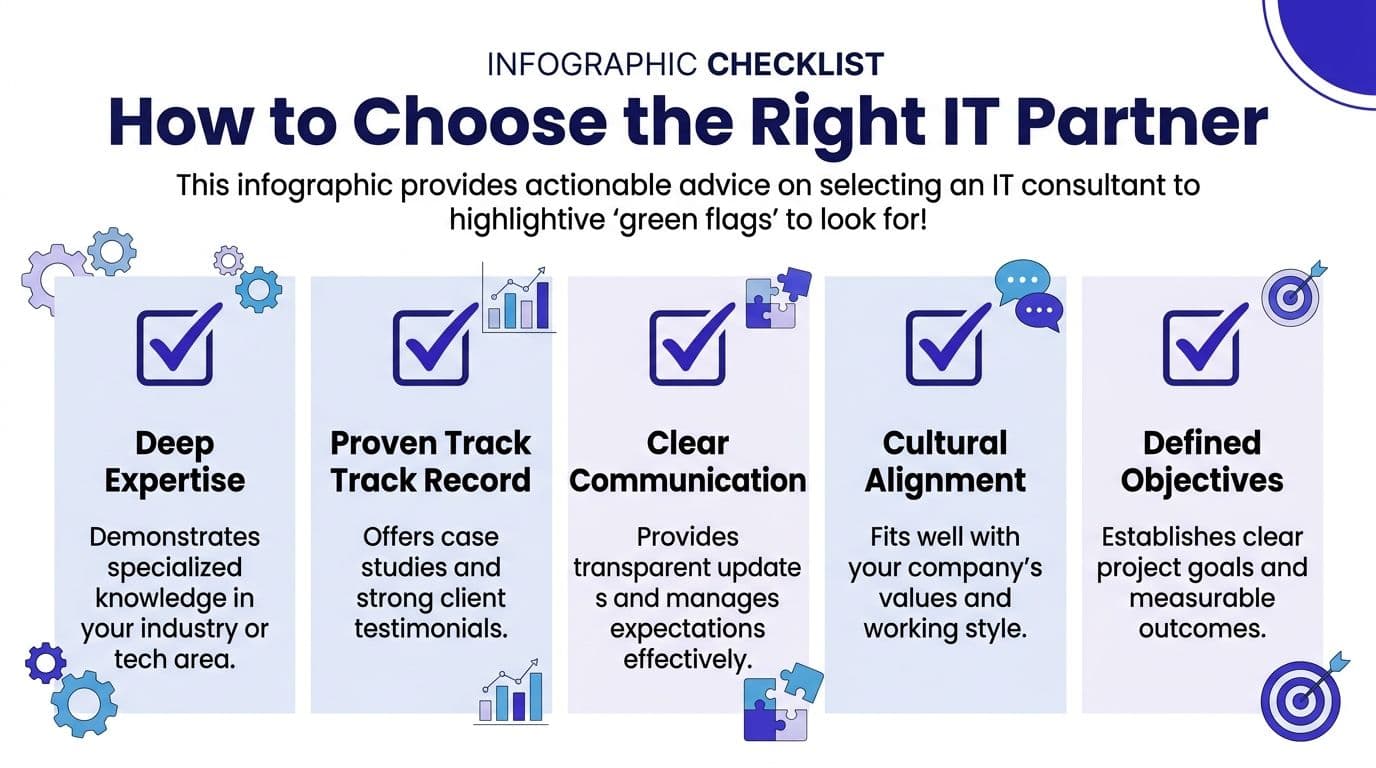
Green flags that matter
Start with business fit, not technical buzzwords.
A strong IT partner should understand the kind of operational problem you are trying to solve. If your issue involves delayed order processing, fragile payment flows, disconnected reporting, or aging infrastructure, the right consultant should connect the technology problem to the business consequence. That is how you tell whether they are diagnosing the issue or just naming tools.
Experience in your setting helps because context shapes better decisions. A firm that has worked with logistics systems, cloud migrations, healthcare platforms, or ecommerce operations will usually know which questions matter early. They can spot risks faster, estimate effort more realistically, and avoid recommending a stack that looks good in theory but creates trouble for your team later.
Credentials still have value. Degrees, certifications, and formal training show baseline discipline. But qualifications only matter if the consultant can apply them to real constraints such as budget limits, compliance needs, staff adoption, and system downtime risk. In practice, you want both. Solid technical grounding and good judgment under real business pressure.
During evaluation, look for signs like these:
- Relevant experience: They can describe similar problems they have solved and explain the business result, not just the technology used.
- A clear method: They can walk you through how they assess the current state, set priorities, make decisions, and manage delivery.
- Plain-English communication: They explain tradeoffs clearly to an owner, manager, or technical lead without hiding behind jargon.
- Business awareness: They ask about revenue impact, workflow bottlenecks, adoption, risk, and timing.
- Execution awareness: They can tell you what happens after the recommendation. Who builds it, who supports it, and how handoffs are handled.
That last point matters more than many buyers expect.
Some firms are strong at advice but weak at follow-through. They can produce a polished roadmap, yet leave you to find another vendor to interpret it and carry it out. A better partner plans with implementation in mind from the start, even if the actual build comes later. That reduces rework because the strategy is grounded in delivery reality.
A good IT partner should reduce confusion, connect technology decisions to business results, and explain what happens after the plan is approved.
Red flags to avoid
Watch how a consultant behaves in the first few conversations. Early habits often become project habits.
Be careful with a firm that prescribes a solution before it understands your systems, staff, and constraints. That is like a contractor quoting a renovation without walking through the building. The recommendation may sound confident, but it is built on guesses.
You should also pause if every answer feels generic. If the consultant keeps steering you toward the same platform, the same process, or the same pricing structure regardless of your situation, that usually means they are selling a package instead of solving a problem.
A few warning signs tend to predict trouble:
- Fast answers with little diagnosis: Good advice starts with questions, system review, and context.
- Unclear scope: If boundaries, assumptions, and owners are fuzzy, timeline and cost usually drift.
- Weak communication: If they cannot clearly explain the problem, your team will struggle during decision-making and rollout.
- No delivery path: If they stop at recommendations and cannot explain how the work gets implemented, accountability can disappear between vendors.
- Sales-heavy conversations: If the discussion focuses more on tools than outcomes, the project may be shaped around what they sell, not what you need.
The best choice is rarely the partner with the flashiest pitch. It is the one that can assess the problem clearly, speak in business terms, and show how strategy turns into real operational change.
From Advice to Action: The Single-Vendor Advantage
Many consulting projects encounter a critical flaw. The strategy is smart, the slide deck looks polished, and everyone agrees on the roadmap. Then the business struggles to execute because the people who designed the plan are not the people building it.
That gap is bigger than many owners expect. According to ManageEngine's discussion of IT consultant execution gaps, 68% of businesses say their biggest consulting gap is not strategy. It is the inability to execute the recommended roadmap without a dedicated engineering team.
That is why hybrid partners are becoming more attractive. They can assess architecture, create the roadmap, and help deploy the solution with the same delivery logic from start to finish. This reduces handoff problems, cuts confusion between advisory and build teams, and keeps accountability in one place.
If you have ever asked what an IT consultant is really supposed to help you do, the strongest answer is this: they should help you move from uncertainty to action. In modern projects, the best version of consulting does not stop at advice. It carries the work into execution.
If you need a partner that can handle both strategy and delivery, Technioz is built for that model. The team plans, builds, and maintains web applications, mobile apps, AI integrations, and cloud infrastructure, while also supporting businesses with consulting and staff augmentation when extra capacity is needed.
Get clear on your technology strategy
Our consulting and strategy guide covers discovery, stack choice, roadmapping, and choosing the right partner.
Get a custom software estimateTechnioz services related to this article